


10 Types of Roof Materials for New Jersey Homes

Updated: Sep 10
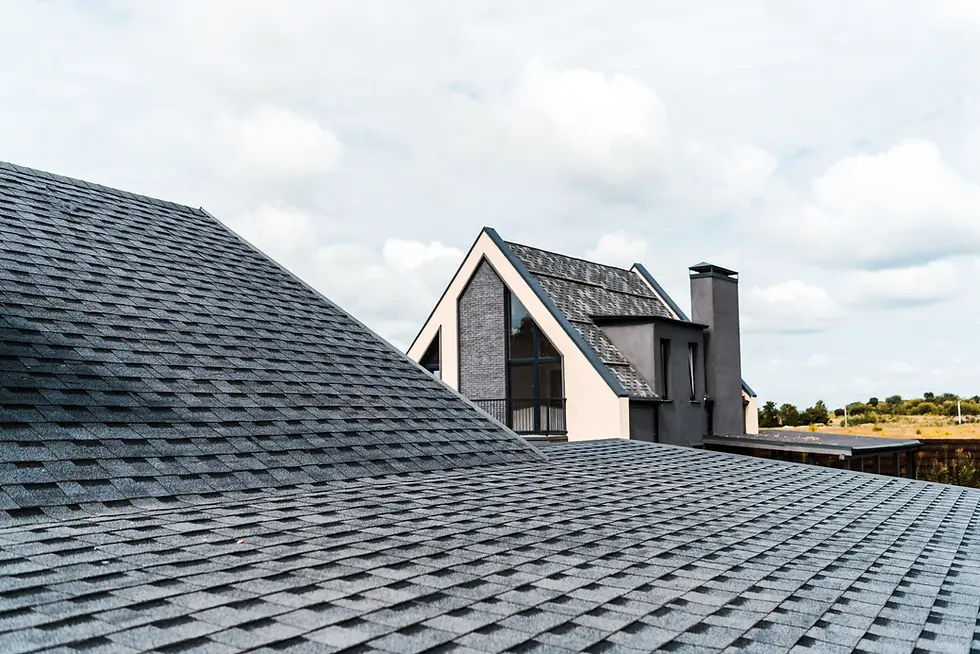
Most New Jersey roofs are asphalt shingle, and for most New Jersey houses that's still the right answer. The materials worth considering instead are metal, wood, slate, synthetic slate, and clay or concrete tile, and the thing that usually decides between them isn't looks or even price. It's weight, and whether your existing roof frame can carry it.
This guide covers ten materials for pitched roofs. Flat and low-slope roofing is a different problem with different products, and it is covered separately below. Federal service-life data is more conservative than the numbers the roofing trade quotes. HUD puts composition shingles at 15 to 30 years, metal standing seam at 20 to 50+, and slate at 50 to 100 (HUD, Durability by Design, 2nd ed., Oct 2015, Table 4-2).
Weight is the real constraint. Asphalt shingle roofing is 3 psf; conventional clay or tile roofing is 27 psf, nine times heavier (HUD, Residential Structural Design Guide, Table 3.2).
New Jersey does not require a permit to re-roof a detached one- or two-family home. Townhouses and condos do need one, and replacing sheathing always does (NJ DCA Construction Code Communicator, Fall 2019, p. 14).
A Class 4 impact rating is not a guarantee. In IBHS testing, no product, rated or not, got past Class 2 impacts without at least one repeat-strike (double impact) location failing (IBHS, Aug 2014). That is a harder condition than the standard single-impact test, so it does not mean Class 4 products fail the rating they carry.
What New Jersey's Climate Actually Does to a Roof
New Jersey roofs deal with snow load, freeze-thaw at the eaves, summer UV, and wind. How much of each depends on where in the state you are, and the spread is wider than people expect.
Annual snowfall at Newark Liberty averages 28.5 inches under the 1991-2020 climate normals. At Charlotteburg Reservoir in West Milford, in the northern highlands, it's 35.0 inches. That's about 23% more snow across a drive of under an hour.
The building code reflects that spread. New Jersey enforces the 2021 International Residential Code for one- and two-family dwellings, adopted at N.J.A.C. 5:23-3.21(a)(1). For ground snow load, NJ DCA Bulletin 19-1 notes that where the ASCE hazard tool returns a case study, designers may fall back on legacy county values: Sussex 50 psf, Passaic 40 psf, Warren, Hunterdon and Morris 35 psf, Somerset 30 psf. Those aren't a general statewide table. They're the fallback for one specific circumstance, and the bulletin lists only these six counties; everywhere else in New Jersey takes its value from the ASCE map directly. Even so, the ranking tells you something real about the northwest corner of the state.
Two things New Jersey homeowners are often told that are worth checking. Seismic design criteria under the building subcode don't apply to one- and two-family dwellings at all, per that same bulletin. And New Jersey doesn't publish a single statewide design wind speed; Bulletin 19-1 points designers to the code's own figures and the ASCE hazard tools for the specific site. If someone quotes you a flat "New Jersey wind speed," ask where it came from. The ASCE Hazard Tool returns design values for a specific address at no cost, which is the honest way to settle it.
Service Life: What HUD's Published Table Says
Almost every roofing article publishes lifespan ranges, and almost none of them say where the numbers came from. The most defensible published source is HUD's Durability by Design, which states its methodology: estimates drawn from industry data plus the National Association of Home Builders and Bank of America "Study of Life Expectancy of Home Components" (Washington DC, February 2007).

Two things stand out.
HUD is more conservative than the roofing trade. The most widely circulated alternative is InterNACHI's life expectancy chart, which puts metal at 40 to 80 years, slate at 60 to 150, and clay or concrete at 100+. HUD says 20 to 50+, 50 to 100, and 50+. Neither is dishonest, and the gap is worth understanding rather than splitting. HUD estimates what a covering delivers in service across a national housing stock and names its methodology. The InterNACHI chart carries no publication date, no revision date and no cited sources, and it disclaims itself as "a general guideline and not as a guarantee or warranty." If you're budgeting a replacement cycle, plan against the conservative number.
HUD doesn't separate architectural shingles from 3-tab. Both fall under "composition shingle" at 15 to 30 years. Plenty of articles will tell you architectural shingles last 30 to 50 years, and that figure has no authoritative published source behind it that we could find. Architectural shingles are heavier, thicker and generally carry longer warranties than 3-tab, and that's a real difference. Treat the specific year counts as marketing until someone shows you the study.
Weight: The Constraint That Rules Out Half the List
This is the part most material guides skip, and it's the part that decides what you can actually put on your house.
Weight of the covering, pounds per square foot

Sources: HUD, Residential Structural Design Guide, Table 3.2 (asphalt, wood shakes, light-weight tile, clay/tile).Slate figures: National Slate Association, a slate industry body.Going from asphalt to clay tile multiplies the load on your frame by nine.
HUD's Residential Structural Design Guide puts asphalt shingle roofing at 3 psf, wood shakes at 15 psf, light-weight tile at 21 psf and conventional clay or tile roofing at 27 psf (Table 3.2; note this edition references ASCE 7-98, so it's an older document, though material dead loads don't move much). The National Slate Association, a slate industry body, gives quarter-inch slate at about 9.35 psf and half-inch at about 18.70 psf.
The Department of Energy makes the practical point directly: tiles are "approximately three times heavier than asphalt roofing, so roof framing and sheathing must be structurally adequate to support the weight," and clay or concrete tile calls for a minimum of 15/32-inch plywood sheathing.
So the honest version of "what roof should I get" is this. A house framed for a 3 psf covering can usually take a heavier architectural shingle or a metal roof without structural work. Moving to slate or tile is a structural decision, not a finish decision, and it needs an engineer's look before anyone quotes you a price. Synthetic slate exists mostly to solve exactly this problem.
How New Jersey Weather Affects Roof Material Performance?

The 10 Roof Materials
1. Three-Tab Asphalt Shingles
This is the baseline everything else gets compared against. Three-tab shingles are flat, single-layer, lowest cost per square, lightest at 3 psf, and the easiest thing in the world to get repaired in New Jersey because every crew stocks them.
HUD's range for composition shingle is 15 to 30 years, and 3-tab sits at the bottom of it. Wind performance is the weak point. If you're replacing a roof anyway, the price gap to architectural is usually small enough that few people choose 3-tab on merit.
2. Architectural (Dimensional) Shingles
Two or more laminated layers, so they're thicker, heavier, and read as more textured from the street. This is the default choice for most New Jersey re-roofs now.
The real advantages over 3-tab are wind resistance and warranty terms rather than a documented lifespan gain. See the ratings section below for what those wind classes actually mean, because that's where the difference shows up on paper.
3. Impact-Resistant (Class 4) Shingles
These are rated against UL 2218, which drops a steel ball onto the shingle with the ball sized to the class. Per the Insurance Institute for Business & Home Safety's summary of the protocol, "the Class 1 projectile is 1.25 in. in diameter, Class 2 is 1.50 in., Class 3 is 1.75 in., and Class 4 is 2.00 in.," and a test fails on "any evidence of opening, tearing, fracturing, cracking, or rupturing on the back of the shingle."
Worth knowing before you pay the upgrade. IBHS tested a range of products and reported that "none of the products tested, basic or impact rated, passed more than Class 2 impacts without at least one double impact location failing the UL 2218 performance criteria." Read that precisely: the failures were at repeat-strike locations, where the same spot is hit twice, which is a harder condition than the standard single-impact test. It does not mean Class 4 products fail the test they are rated against. It does mean the rating describes performance under one specific protocol rather than a guarantee against hail.
On the insurance question: New Jersey doesn't appear on the NAIC's 2023 survey of state mitigation programs, and NJ DOBI's consumer guide to homeowners insurance doesn't list a roof-related discount. That's absence of evidence for a state mandate, not proof no carrier offers one. Ask yours directly.
4. Standing Seam Metal
Concealed-fastener panels with raised seams. HUD gives metal standing seam 20 to 50+ years; the Department of Energy says "a metal roof can last up to 50 years or more."
Metal sheds snow well, which matters in Sussex, Passaic and Warren counties more than it does in Camden. It's light enough to go over most existing framing. DOE also notes metal roofs are generally considered a fire-resistant covering. The downsides are cost, the shorter list of crews who install it properly, and the fact that a bad seam detail on a low-slope run will leak in ways an asphalt roof wouldn't.
5. Metal Shingles and Panels
Metal formed to imitate shingle, shake or tile profiles, usually exposed-fastener or interlocking rather than standing seam. Cheaper to install than standing seam and lighter than the materials they mimic.
The trade-off is the fastener count. Exposed-fastener systems have more penetrations, and every penetration is a gasket that ages.
6. Wood Shingles and Shakes
Wood roofing in New Jersey means cedar, almost without exception. Shingles are sawn and uniform; shakes are split and thicker. HUD puts wood shingle at 15 to 30 years, the same band as composition shingle, which surprises people who assume wood lasts longer because it costs more.
At 15 psf, shakes are five times the weight of asphalt. They also need maintenance, and fire rating depends entirely on treatment and assembly. Check your municipality before committing, and read the fire section below.
7. Natural Slate
Slate is the long-life option, at 50 to 100 years per HUD. Some slates run far longer, though the sources claiming 150 or 200 years are slate industry publications, so weigh them accordingly.
The constraint is structural and it's absolute. Quarter-inch slate roughly triples the load versus asphalt; half-inch roughly six times it. Slate also can't be re-covered over, and it can't be walked on carelessly, which makes every future repair a specialist job.
8. Synthetic Slate and Composite
Molded polymer or rubber-composite products designed to look like slate or shake at a fraction of the weight. This is the answer for a homeowner who wants the look on a frame that can't carry the real thing.
Be careful with lifespan claims here. HUD's table doesn't cover synthetic steep-slope products, and the products themselves are newer than the service lives being advertised for them, so nobody has 50 years of field data. Judge these on the warranty and the manufacturer's track record.
9. Clay Tile
Long-lived, at 50+ years per HUD, and genuinely durable in the right assembly. It's also the heaviest thing on this list at 27 psf.
Clay tile is uncommon on New Jersey housing stock outside specific architectural styles, which means fewer local crews with real experience and a harder time matching tile for repairs in twenty years.
10. Concrete Tile
Concrete tile sits in the same weight class as clay and starts the same structural conversation, at 50+ years. Light-weight tile products bring it down to about 21 psf, which is still seven times asphalt.
Concrete tile costs less than clay and comes in more profiles. It's heavier than most New Jersey roofs are framed for either way.
Flat and Low-Slope Roofs
If part of your roof is flat or nearly flat, none of the above applies to that section. Low-slope roofing uses membranes rather than shingles or tiles: EPDM rubber, TPO, PVC, and built-up roofing. HUD gives built-up roofing 12 to 30 years and synthetic membrane 20+.
The selection logic is different enough that we've written it up separately. See best roofing materials for flat roofs for membrane comparisons, and note that green roofs, which occasionally come up in New Jersey residential work, are a low-slope assembly and belong in that conversation too.
How to Read the Ratings on a Roofing Product
Three sets of letters appear on roofing spec sheets, and they measure different things.
Fire: Class A, B or C
Tested under ASTM E108 or UL 790. The classes describe the severity of fire exposure the covering is effective against, not a burn-through time, which is the single most common misreading.
Per ASTM E108, Class A coverings are "expected to be effective against severe fire exposure," Class B against "moderate fire exposure," and Class C against "light fire exposure." All three must also stay in position and not throw burning brands.
Impact: UL 2218 Class 1 to 4
Covered in material 3 above. Class 4 is the top rating, tested with a 2.00-inch steel ball. IBHS's testing suggests reading it as a real improvement in impact tolerance rather than as a promise your roof survives a hailstorm intact.
Wind: ASTM D7158 and ASTM D3161
Two different test methods, and knowing which one a product was rated under matters.
Standard | Class | Rated to |
ASTM D7158 (uplift) | D | Vult up to 116 mph |
ASTM D7158 (uplift) | G | Vult up to 155 mph |
ASTM D7158 (uplift) | H | Vult up to 194 mph |
ASTM D3161 (fan-induced) | A | 60 mph |
ASTM D3161 (fan-induced) | D | 90 mph |
ASTM D3161 (fan-induced) | F | 110 mph |
D7158 figures are from an Asphalt Roofing Manufacturers Association technical bulletin dated March 2026, keyed to the current ASCE 7. Older sources give slightly lower numbers because they're keyed to ASCE 7-10, so check the vintage of any table you're handed. D3161 figures are from NRCA's Professional Roofing, September 2018.
Two caveats that get dropped constantly. D7158 class ratings assume standard conditions: wind exposure category B or C, mean roof height not over 60 feet, and no topographic speed-up. A shingle rated to 155 mph isn't rated to 155 mph on an exposed ridge. And per NRCA, D3161 "makes no accommodation for building height or mean roof height, building exposure, building importance factor or risk category," which is why D7158 is the more meaningful of the two.
To work out which class you actually need, look up the design wind speed for your address in the free ASCE Hazard Tool and take that to the contractor rather than accepting a general "wind rated" claim.
Do You Need a Permit to Replace a Roof in New Jersey?
For a detached one- or two-family home, no. That is settled in New Jersey regulation, and it's more generous than most homeowners assume. Confirm with your municipal construction office before work starts anyway, because the construction-code exemption doesn't override historic-district review, zoning, or an HOA.
The NJ Department of Community Affairs put it plainly in the Construction Code Communicator, Fall 2019:
"Re-Roofing – No permit is required for existing detached one- or two-family dwellings for the roof covering materials. This include all buildings such as garages, sheds, pool houses, and the like that are accessory to a detached one- or two-family home (Group R-5). Stripping the roof down to existing sheathing or putting on a second layer of roof covering does NOT require a permit. Townhouses and condos will require roof permits. Replacing sheathing will always require a permit."
The underlying rule is N.J.A.C. 5:23-2.7, which lists "the repair or replacement of existing roof covering on detached one- and two-family dwellings" as ordinary maintenance, and ordinary maintenance "may be made without filing a permit application with or giving notice to the construction official."
Four qualifiers do the work here, and they're where most advice goes wrong:
Accessory buildings are included. Detached garages, sheds and pool houses on a one- or two-family property fall under the same exemption.
Townhouses and condos are not. Those need a permit.
Sheathing always needs a permit. The moment the job goes past the covering into the deck, you're in permit territory.
Structural or fire safety work is excluded from ordinary maintenance entirely, per N.J.A.C. 5:23-2.7(b)4.
Separately, the code caps how many layers you can stack. Under 2021 IRC Section R908.3.1.1, you can't re-cover a roof that already has two or more applications of any roof covering, and R908.3 requires that a roof replacement remove existing layers down to the deck. So New Jersey lets you add a second layer without a permit, and the code stops you at two. Both facts are worth knowing before someone offers you a cheap layover. And because a re-roof needs no permit, there is no inspection coming to catch a third layer. That check is yours to make.
Cool Roofs: Do They Make Sense in New Jersey?
Reflective roofing lowers surface and attic temperatures in summer. The EPA reports that cool roofs "can lower maximum indoor temperatures by 1.2 to 3.3°C (2.2 to 5.9°F)" in non-air-conditioned buildings, and that reflectance "can reduce peak cooling demand by 11 to 27%" in air-conditioned residential buildings.
The catch is real and the EPA states it: cool roofs "may increase energy use in buildings during winter months in cold climates," a heating penalty the agency describes as "typically offset by summer cooling energy savings" because the winter sun sits lower and the days are shorter.
Where does New Jersey land? Nobody publishes a state-specific net figure, and the national studies use climate-zone systems that don't map cleanly onto New Jersey, so anyone quoting you a precise New Jersey percentage is extrapolating. What is documented: Lawrence Berkeley National Laboratory measured conventional dark shingles at 0.05 to 0.10 solar reflectance, against 0.25 to 0.29 for most cool shingles sold today. The gap is real. The dollar value in a heating-and-cooling climate like New Jersey's is not something we can source, so we won't put a number on it.
How These Materials Rank on Cost
Installed cost generally runs in this order, cheapest first: three-tab asphalt, architectural asphalt, impact-resistant asphalt, metal shingles and panels, wood, synthetic slate, standing seam metal, concrete tile, clay tile, natural slate.
Positions move with roof complexity, pitch, access and how much tear-off is involved, and any material needing structural work carries that cost on top of the covering. Use the ordering to narrow the shortlist, then get real numbers for the two or three you're actually choosing between. National average figures are not much help here, because the spread between a simple gable and a cut-up roof with valleys, dormers and skylights is wider than the spread between materials.
How to Actually Choose
Work through it in this order, because the early questions eliminate options and the late ones are preferences.
What can the frame carry? If you want slate or tile, this is question one and it needs an engineer, not a salesperson. Everything at 3 to 15 psf is usually fine on existing framing.
How long do you plan to own the house? A 15-to-30-year covering on a house you'll sell in eight is a different calculation from one you'll retire in.
How much snow does your roof actually see? Northern Passaic and Sussex sit at the top of the state's snow-load range; Somerset and the counties south of it sit lower. Metal sheds; complex rooflines with valleys and dormers hold.
What are the wind and fire ratings, and under which standard? Ask for D7158 class, not just "wind rated."
Who is going to repair it in ten years? A material with three crews in your county who can service it is worth less than the spec sheet suggests.
Then look at it. Appearance is a real criterion. It's just the last one.
Getting a Recommendation for Your Roof
Material choice is mostly determined by the house: what the frame can carry, what the roof geometry does with snow and water, and what's already up there. Anyone recommending a material before they've been on the roof is selling, not advising.
NJ Gold Star Construction handles roof repair, replacement and installation across northern New Jersey, including Totowa, Wayne and Hawthorne. NJ HIC #13VH13359900. If you're not sure whether you're replacing yet, start with the signs a roof is done. Call (862) 271-1225 or request an estimate.
Frequently Asked Questions About Roof Materials
Do I need a permit to replace a roof in New Jersey?
Not for a detached one- or two-family home, including accessory buildings like detached garages and sheds. NJ DCA classifies re-roofing as ordinary maintenance, and that covers stripping to the sheathing or adding a second layer. Townhouses and condos do need a permit, and replacing the sheathing always needs one.
Which roof material lasts the longest?
Slate, at 50 to 100 years per HUD's published table, followed by concrete and clay tile at 50+ and standing seam metal at 20 to 50+. Whether you can use slate or tile is a structural question first, since they weigh three to nine times what asphalt shingle does.
How long do asphalt shingles last?
HUD gives composition shingle a service life of 15 to 30 years, which covers both 3-tab and architectural products. Longer figures circulate widely for architectural shingles but we could not find an authoritative published source for them.
Are architectural shingles worth it over 3-tab?
Usually yes, though not for the reason most often given. No authoritative source separates their service lives. The documented advantages are wind resistance and warranty terms, and the price gap on a full re-roof is generally small.
How many layers of roofing can you have in New Jersey?
Two. Under 2021 IRC Section R908.3.1.1, which New Jersey has adopted, a roof can't be re-covered if it already carries two or more applications of any roof covering. A replacement past that point has to come off down to the deck.
Do impact-resistant shingles get you an insurance discount in New Jersey?
There doesn't appear to be a state mandate. New Jersey is absent from the NAIC's 2023 survey of state mitigation programs, and NJ DOBI's consumer insurance guide lists no roof-related discount. Individual carriers may still offer one, so ask yours.
Is metal roofing a good choice for New Jersey snow?
It sheds snow better than shingle, which helps in the northwest counties where ground snow loads are highest. It's light enough for most existing framing. Ask about snow guards if the roof discharges over a walkway or a driveway.
What does a Class A fire rating mean?
Under ASTM E108, it means the covering is expected to be effective against severe fire exposure. Class B covers moderate exposure and Class C light exposure. The classes describe exposure severity, not how long a roof resists burning through.
Sources
U.S. Department of Housing and Urban Development, Office of Policy Development and Research, Durability by Design: A Professional's Guide to Durable Home Design, 2nd edition, October 2015, Table 4-2.
U.S. Department of Housing and Urban Development, Residential Structural Design Guide, Table 3.2, Dead Loads for Common Residential Construction. References ASCE 7-98.
New Jersey Department of Community Affairs, Construction Code Communicator, Vol. 31 No. 3, Fall 2019, p. 14, "Ordinary Maintenance/Minor Work, Continued."
N.J.A.C. 5:23-2.7, Ordinary maintenance, New Jersey Uniform Construction Code. New Jersey adopts the 2021 IRC at N.J.A.C. 5:23-3.21(a)(1).
2021 International Residential Code, Sections R908.1, R908.3 and R908.3.1.1 (roof replacement and re-covering).
New Jersey Department of Community Affairs, Bulletin 19-1, "Design Loads for Ground Snow, Wind and Seismic", issued September 2019, revised September 2022.
NOAA National Centers for Environmental Information, U.S. Climate Normals 1991-2020, annual snowfall normals, stations USW00014734 (Newark Liberty International Airport) and USC00281582 (Charlotteburg Reservoir). Retrieved September 9, 2026.
ASTM International, ASTM E108-25, Standard Test Methods for Fire Tests of Roof Coverings, 2025.
Insurance Institute for Business & Home Safety, "Relative Impact Resistance of Asphalt Shingles: Summary of UL 2218 Impact Tests", August 2014. Source for the UL 2218 projectile diameters and pass/fail criterion quoted above, as well as the impact test results.
Asphalt Roofing Manufacturers Association, "Using ASTM D7158 Where Standard Conditions Do Not Apply", March 2026.
National Roofing Contractors Association, Professional Roofing, September 2018, asphalt shingle wind resistance classifications.
U.S. Department of Energy / Pacific Northwest National Laboratory, Building America Solution Center, "Metal Roofs" (updated September 26, 2021) and "Clay or Concrete Tile Roofs" (updated December 6, 2022).
National Slate Association, "Common Myths About Slate Roofing", published March 23, 2023, modified July 15, 2024. Slate industry body.
U.S. Environmental Protection Agency, "Using Cool Roofs to Reduce Heat Islands", last updated June 18, 2026.
Lawrence Berkeley National Laboratory, Next-Generation Factory-Produced Cool Asphalt Shingles: Phase 1 Final Report, LBNL-2001007, November 2016.
National Association of Insurance Commissioners, "State Mitigation Programs", 2023.
New Jersey Department of Banking and Insurance, A Consumer Guide to Homeowners, Renters and Condominium Insurance.
International Association of Certified Home Inspectors, "InterNACHI's Standard Estimated Life Expectancy Chart for Homes". Undated, no cited methodology; used here only as the contrasting trade figure.
American Society of Civil Engineers, ASCE Hazard Tool, address-level design wind, snow and seismic values.
The right roof material depends on your home’s structure, roof pitch, budget, and how long you plan to stay in the home. A professional roofing inspection helps determine which materials are best suited for your property and New Jersey’s climate.


Comments