
Have a Project in Mind? Contact Us Now
Call Us Now: (862) 271-1225
Email Us: njgoldstarconstruction@yahoo.com


New Decks Built in Totowa NJ: Footings, Frame, Ledger and Decking
A new deck is a small structure carrying people well above the ground, and the part that decides how long you keep it is the part you never look at. This page covers footings, posts, beams, joists, the ledger board that ties it to your house, and how the four decking materials really compare. Call before you pick a board color.

What Holds the Deck Up Gets Designed Before Anyone Picks a Board
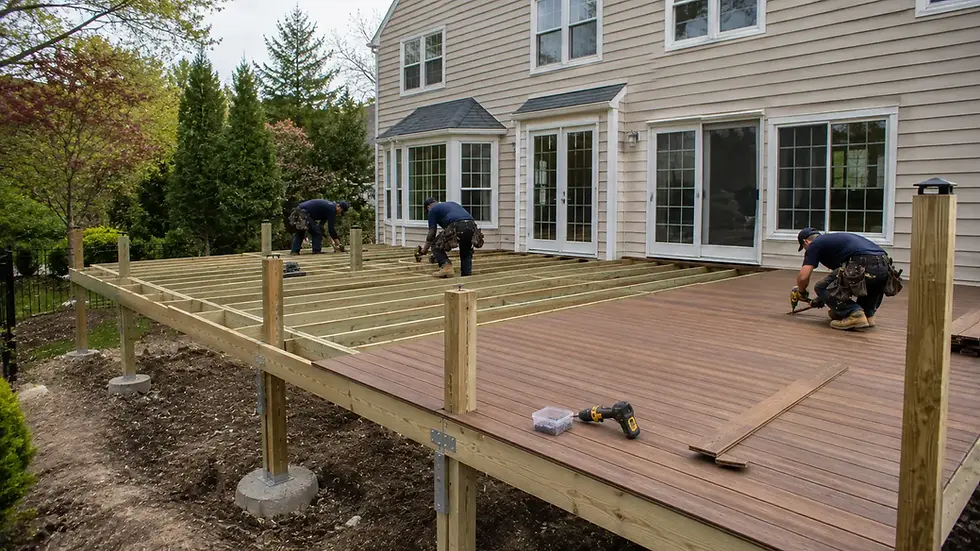
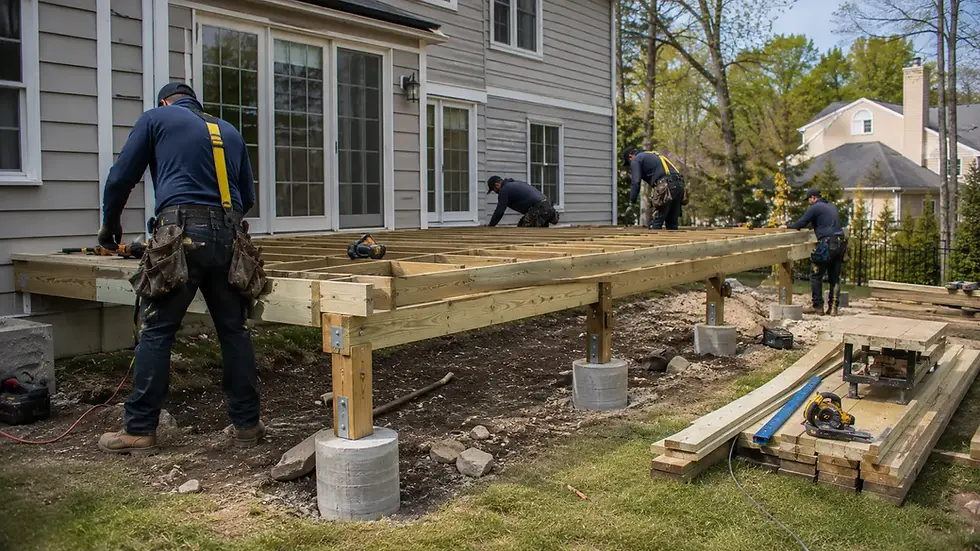
Footings Bear on Solid Ground
Holes go down past the freeze depth the town enforces and land on undisturbed soil, not on the backfill left behind when the house was built.
Frame Sized to the Decking
Joist spacing is set for the boards you chose, because composite, PVC and a diagonal layout each want the frame built differently underneath.
The Ledger Gets Opened and Flashed
Siding comes off so we can see what the deck is bolting to, flash over the top of the ledger, and send water back out past the frame.
Guards Built Into the Frame
Rail posts are tied through the framing with blocking behind them rather than screwed to the outside face of a rim joist and hoped for.
SIGNS YOU MAY NEED A NEW DECK BUILT
Most new decks get built for one of a handful of reasons, and none of them are about color. Stand at your back door, then walk the yard and look at the grade, the door swing and the furniture you cannot use outside.

THE BACK DOOR OPENS ONTO A DROP
A door with a single wooden step, a stack of blocks, or nothing at all under it. The house was built with a deck in mind and never got one, so the back of the property goes unused.
THE TABLE ONLY FITS ONE WAY
Chairs backing into the rail, one person trapped in the corner, and the grill pushed against the siding. A surface too small for the furniture gets used twice a summer and then abandoned.
THE YARD FALLS AWAY BEHIND THE HOUSE
Where the ground drops off behind the house, a patio means retaining walls and imported fill. A framed deck spans that fall on posts instead and leaves the slope alone.
YOU ARE PLANNING SOMETHING HEAVY
A hot tub, a stone-topped outdoor kitchen or a run of built-in planters are concentrated loads. They belong in the design before the footings are laid out, not bolted on afterward.
WHAT WE DO
OUR NEW DECK BUILDING SERVICES
01
Footings, Posts and Frame
Layout is set out from the house and squared, holes are dug to the depth the town requires and inspected before concrete, and posts land on hardware that keeps end grain up out of standing water. Beams, joists and blocking go together with connectors and fasteners rated for outdoor use in treated lumber, not whatever is in the truck.
02
Ledger, Flashing and Freestanding Frames
Where a deck attaches to the house, siding is cut back so we can see the framing behind it, confirm the deck is bolting into a member that can carry it, and flash over the top so water sheds outward. Where the wall cannot take a ledger, we build the frame freestanding on its own line of posts.
03
Decking, Fastening and Trim
Pressure-treated softwood, cedar, wood-plastic composite and PVC all get installed to the gaps and fastener patterns their maker specifies, which differ. Boards can be face-screwed, plugged or run on hidden fasteners. Joints land on blocking, cut ends get sealed on wood, and the frame is wrapped so no bare framing shows at the edge.
04
Railings, Stairs, Lighting and Skirting
Guards are built as structure, with posts tied into the frame and infill in wood, metal balusters, cable or glass. Stairs get equal rises, a proper landing pad at the bottom and a graspable handrail. Low-voltage lighting is wired through the frame before decking goes down, and skirting closes off the space underneath.
The Benefits of a Deck Built From the Ground Up
-
Footings taken below the freeze depth and landed on undisturbed soil stop the seasonal lift and drop that racks a frame, opens board joints and throws a rail out of plumb.
-
A flashed ledger sends wall water out over the frame instead of into the band joist behind it, the one detail separating a deck that lasts decades from one quietly rotting off the house.
-
Joist spacing chosen for the boards you actually picked means no bounce underfoot and no long-term sag between joists, which is what makes composite look wavy on an undersized frame.
-
Rail posts anchored through the framing resist somebody being pushed against them sideways, which is exactly the load a guard exists for and the one a face-screwed post fails at.
-
Stairs with equal rises and a solid landing pad at the bottom stop the sinking last step that catches people at night and turns the grass below into a mud patch.
-
Getting the grade, the downspout outlets and the ground cover sorted before the frame closes the space means you are not crawling under a finished deck later to fix drainage.

NEW DECK CONSTRUCTION GUIDE
A deck is a small building that happens to have no roof and no walls. Everything you enjoy sits on top: the boards, the rail, the furniture, the view. Everything that decides how long you keep it sits underneath, in the footings, posts, beams and the one board that ties the frame to your house.
Footings, and What They Are Actually Bearing On
Nothing above ground is worth much if the bottom of the structure moves. A deck frame is stiff by design, so when one support settles or lifts, the whole assembly twists rather than sagging in one spot. Board joints open, the rail goes out of plumb, the door starts catching.
Why a Footing Reaches Below the Freeze Depth
Wet soil expands when it freezes and lifts whatever sits in it. A footing goes down past the depth the ground freezes in a normal winter, so it bears on soil at a steady temperature all year. How deep that is comes from the code your town enforces, confirmed by the inspector before concrete goes in.
What the Ground Under Your Yard Turns Out to Be
Older Bergen and Passaic County lots rarely give clean soil the whole way down. Close to the house you are digging in the trench backfilled when the foundation went in, and loose backfill will not carry a post. Further out there can be rock, an old slab or ground that stays wet all spring.
How the Post Meets the Concrete
A post buried in dirt has a short career. Wood held in wet soil with no air around it rots from the bottom up and gives no warning at eye level. The concrete comes up above grade instead, and the post sits on a metal base that keeps end grain clear of standing water and holds it against uplift.
Posts, Beams and the Path a Load Takes
Follow the weight. You stand on a board, the board hands the load to the joists, the joists to a beam, the beam to the posts, the posts to the footings, the footings to the soil. Every junction is a decision, and the weak one is almost never the lumber. It is the connection.
Beams Sitting on Posts, or Bolted to Their Sides
A beam can sit on top of the post, bearing on the end or in a notch cut into it, so load travels straight down through solid wood. Or it can be bolted to the side, which puts the whole load onto fasteners. Bearing is stronger and ages better. A side connection gets through-bolted, never hung on deck screws.
Overhang, and Keeping a Tall Frame From Racking
Joists may run past the beam by an amount the span table allows, which keeps posts back out of the way underneath. A low deck is braced by its own geometry, but the same frame on long posts over a slope can sway, because four pin-jointed corners have nothing stopping them leaning. That is what diagonal bracing is for.
Joists, Blocking and What You Feel Underfoot
Homeowners judge a frame with their feet before their eyes. A deck that gives when two people walk in step is not unsafe, but it was built to a minimum. Strength is what the code sets. Stiffness is a comfort decision made on top of it, in the framing.
Spacing, Span and the Decking You Chose
Joist spacing is not one number for every deck. Solid wood carries over a wider spacing than most composite and PVC will, and boards run on a diagonal span further, so the joists come closer. The manufacturer states the spacing their board is approved for, and a synthetic board on an overstretched frame reads wavy in low evening light.
Blocking, and Hardware That Lives Outdoors
Short pieces fitted between joists stop them rolling on edge, share a load between neighbors, stiffen the field, and put solid wood where a board joint needs something to fasten to. The chemistry in treated lumber is hard on ordinary steel, so connectors, bolts and hanger nails all have to be rated for contact with it and for outdoor exposure.
The Ledger Board, and Why It Decides Everything
If an attached deck is ever going to hurt somebody, this is where it starts. The ledger is the board bolted flat against the house that carries one entire edge of the frame. Decks that come down rarely break in the middle. They peel off the wall, for one of two reasons.
What the Ledger Is Fastened To
The first reason is attachment. A ledger has to be through-fastened into the framing of the house, normally the band running around the edge of the floor structure. Not into sheathing, not into siding, and not into a brick or stone veneer, because a veneer is a skin hung on the wall and is not carrying the house.
Why the Siding Has to Come Off
You cannot flash what you cannot see, and you cannot verify framing through a piece of vinyl. A ledger bolted straight through siding stands off the wall on the high points of the profile and leaves a slot behind it collecting everything running down the house. The siding is cut back, the sheathing looked at, then closed up to the deck.
Flashing So Water Sheds Outward
The second reason is water. Flashing goes over the top of the ledger, tucked up behind the wall barrier and lapped out over the front face, so rain runs onto the deck side and drips clear. Lapped the other way it funnels the wall into the joint. The metal also has to suit treated lumber, since some corrode fast against it.
When a Freestanding Frame Is the Better Answer
Sometimes the right move is not to touch the house at all. A freestanding deck carries its house-side edge on its own beam and posts, so there is no ledger and no flashing to get wrong. That is often the call over a cantilevered floor, against stucco or masonry veneer, or where the band joist cannot be confirmed.
Decking Materials, Compared on What Actually Differs
Four families of decking cover almost every deck built around here. What separates them is how long the surface lasts, how it greys, how it feels under bare feet in July, what upkeep it asks, how it takes a fastener, and where it sits on cost. Cost is given as a band, because grade and layout move it more than the material name.
Pressure-Treated Softwood
-
Service Life: Long when kept coated, but much shorter when left untreated
-
Weathering: Greys within one or two seasons, then begins to check and split
-
Heat Underfoot: Coolest of the four materials
-
Upkeep: Wash and recoat on a regular schedule
-
Fastening: Accepts screws easily but may split near the ends without pre-drilling
-
Relative Cost: Lowest
Cedar
-
Service Life: Moderate to long, depending on the grade and coating
-
Weathering: Develops a soft, even silver color when left untreated
-
Heat Underfoot: Cool and similar to pressure-treated softwood
-
Upkeep: Wash yearly and recoat to preserve its color
-
Fastening: Soft and easy to screw into but susceptible to marks and dents
-
Relative Cost: Middle
Wood-Plastic Composite
-
Service Life: Long, with capped boards generally lasting longer
-
Weathering: Retains its color but may lighten during the first year
-
Heat Underfoot: Warmer than wood, especially in darker colors
-
Upkeep: Requires washing but no coating or sealing
-
Fastening: Uses hidden clips in side grooves or plugged face screws
-
Relative Cost: Upper middle
PVC and Fully Synthetic Boards
-
Service Life: Longest of the four materials because there is no organic material to rot
-
Weathering: Retains its color the longest and has no wood grain to raise
-
Heat Underfoot: Warmest material, particularly in darker colors
-
Upkeep: Requires washing only
-
Fastening: Expands and contracts most with heat, so gaps and fasteners must follow the manufacturer’s specifications
-
Relative Cost: Highest
How the Deck Gets Read on the Estimate Visit
Most of what sets the scope is under the boards and behind the siding, so that is where the time goes. Every post base, both ends of each joist, the beam, the stair stringers and the ledger get probed rather than eyed, and suspect boards get lifted. You are welcome to follow along, and most homeowners do.
At the end you get three things kept separate: what is a safety item, what is comfort or appearance, and what is feeding the water. If something needs doing before the deck is used again, you hear it on the day.
Replacing Boards, and the Matching Problem
Board replacement is the most requested deck repair and the most misunderstood, because the fitting is easy and the matching is not. A board comes out in minutes. Making the new one look like it belongs depends on the age of the deck and where the bad board sits.
Taking One Board Out Without Wrecking Its Neighbors
The board is cut over framing at each end of the damaged length, the fasteners backed out or their heads sheared, and the piece lifted clear. Cuts land over a joist so the replacement has bearing. The boards either side get held down while it comes up, since prying against a fastened board cracks it.
The New Board Will Look New for a Season
A pressure-treated board that has been outside for years has lost its green cast, silvered off and shrunk across its width. A new one is wetter, fatter and a different color, and keeps moving for a season while it dries. Cedar does the same. Composite fades too, and an older run rarely matches current stock.
Where the Replacement Board Should Come From
On a deck with a hidden run, under a bench, tight to the house, or behind a planter box, take the weathered board from there for the visible spot and put the new one where nobody looks. Otherwise new boards go in as a full row, so the change reads as a line rather than a patch.
Repairs to the Frame Underneath
Once the failure is structural, the repair is carpentry with the load taken care of first. None of it is exotic, but all of it depends on reaching sound wood and putting the right hardware back. The sizes, fasteners and spacings come from the code your town enforces, confirmed on site rather than assumed.
Sistering a Joist That Has Gone Soft at One End
Where a joist has rot at one end but sound wood along the rest, a matching member runs alongside it, picking up the same bearing at both ends, fastened through so the new piece takes the load. The rotted section is cut away. Sistering works when damage is local, not down a whole row.
Replacing a Post and Its Base
The load above the post is picked up and supported before anything is cut. The failed post comes out, the footing and the surface it bears on get looked at, and the new post goes back on hardware holding it clear of standing water. That detail decides whether you do this again.
Re-Securing or Rebuilding a Railing
A loose railing is fixed at the post connection: getting at how the post is attached, checking whether the wood it is bolted to is still solid, and putting proper hardware through it rather than another screw beside the last one. Where the rim behind is soft, the rim is repaired first.
Replacing Corroded Fasteners and Hardware
Hardware corrodes, fastest where the wrong metal was put against treated lumber. A rusted hanger, a nail with no shank left or a bolt weeping brown down the wood is a connection no longer doing its job. Those get replaced with the right type, into fresh wood where the holes have opened out.
Opening the Siding to Inspect and Reflash the Ledger
Where the ledger is suspect, the only honest inspection is to take the siding off above it and look. That shows the top edge, whether anything was fitted over it, what the board is fastened with, and the framing behind. It goes back with flashing that carries water out over the face, wet material replaced, the wall closed up.
Refinishing Against Replacing
Cleaning, sanding and sealing is real deck work, and it is regularly sold as the answer to problems it cannot touch. The boundary is worth being clear about, because a finish laid over the wrong thing hides the evidence you would otherwise use to catch a problem early.
What Cleaning, Sanding and Sealing Actually Do
A proper clean lifts the weathered gray layer, the algae film and the dirt worked into the grain. Sanding knocks back raised fiber and takes the splinter risk out of a sound board. A sealer then slows how quickly the wood takes on and gives off water, which reduces cupping and splitting.
What a Finish Cannot Do
It cannot put strength back into wood that has gone soft. It cannot bridge a split, flatten a cupped board or give a loose fastener something to hold. It will not stop rot fed by a downspout or an unflashed ledger, because that water arrives where the finish never reaches.
Choosing Between a Board Swap and a Refinish
The test is whether the boards are tired or gone. Tired means gray, slightly splintery and still firm everywhere you probe, and those refinish well. Gone means soft at the ends, split through, or cupped enough to hold water. Swap the gone ones first, then finish the whole surface so it reads as one deck.
Clean, Sand, and Re-Seal
-
What It Addresses: Surface graying, algae film, and splinters
-
Where It Suits: Boards that remain firm wherever they are inspected
-
What It Leaves You With: Recoating every few seasons, with no changes below the surface
Replace Individual Boards
-
What It Addresses: Split, cupped, or soft boards in a few locations
-
Where It Suits: A sound frame beneath scattered surface failures
-
What It Leaves You With: New boards that gradually weather to match the older ones
Replace the Entire Walking Surface
-
What It Addresses: A deck surface with widespread deterioration
-
Where It Suits: Decks that remain dry and structurally sound underneath but are worn on top
-
What It Leaves You With: A new walking surface supported by the original structure
Frame Repairs: Sistering, Posts, and Hardware
-
What It Addresses: Localized rot and failed connections
-
Where It Suits: Damage affecting a few framing members with sound wood on either side
-
What It Leaves You With: A functional frame after the source of the water damage is corrected
Reflash and Refasten the Ledger
-
What It Addresses: Water entering behind the deck where it meets the wall
-
Where It Suits: Decks showing dampness or staining around the ledger connection
-
What It Leaves You With: The primary source of rot addressed and the siding properly closed
Rebuild the Structure
-
What It Addresses: Widespread frame rot or an improperly constructed attachment
-
Where It Suits: Decks beyond the point where localized repairs are practical
-
What It Leaves You With: A properly planned structural rebuild instead of continued patching
Pressure-Treated Softwood
The default, and no shame in it. It is the cheapest route to a properly framed deck, it is strong, it holds a screw, and it is what almost every frame is built from. Left bare it greys in a season, checks along the grain, cups, and works fasteners loose as it moves.
Cedar
Cedar is chosen for how it looks and how it feels. It is lighter than treated softwood, stays cooler than any synthetic in August, and left alone it silvers to an even soft grey rather than the blotchy grey treated lumber goes. The trade is softness: it dents under a dropped tool and scuffs under furniture legs.
Wood-Plastic Composite
Composite is wood flour and plastic pressed together, and most of what is sold now carries a harder shell on the visible faces. That shell is why current composite resists staining and fading far better than the early generation. No sanding, no sealing, no recoating. It does run hotter than wood in sun, and usually wants closer joist spacing.
PVC and Fully Synthetic Boards
PVC has no wood in it, so there is nothing in the board for rot or insects to be interested in. It is the lightest, the most colorfast and the longest lasting. It is also the warmest underfoot and moves most across a hot day, which is why its gapping instructions are not suggestions.
How the Boards Are Fastened Down
Two schools, and the choice changes how the deck looks on day one and how it behaves in year ten. Either way the boards are laid with a gap so water falls through and the material can move, and how much depends on the board and how wet it is that day. The manufacturer publishes that figure.
Face-Driven Screws
-
Surface Appearance: Two visible screw heads at every joist, arranged in neat lines
-
Where It Suits: Pressure-treated softwood, cedar, and decks where cost is the primary consideration
-
Future Requirements: Individual boards are easy to inspect, tighten, or remove
Face Screws with Matching Plugs
-
Surface Appearance: Nearly invisible, with a small color-matched plug covering each screw
-
Where It Suits: Composite and PVC decking where strong face-screw fastening is preferred
-
Future Requirements: Plugs must be drilled out to remove a board, and replacements require matching plugs
Hidden Clips in a Side Groove
-
Surface Appearance: Clean and uninterrupted, with no visible fasteners
-
Where It Suits: Grooved composite and PVC boards installed over a straight, properly blocked frame
-
Future Requirements: Boards in the middle of the deck usually must be removed in sequence instead of individually
Hidden Screws Angled Through the Side
-
Surface Appearance: Clean surface without visible screw heads
-
Where It Suits: Hardwood, ungrooved boards, and perimeter boards on a hidden-clip deck
-
Future Requirements: Installation takes longer, and replacing a board usually requires working inward from an edge
The Line Where Repair Stops Being the Right Answer
This is the part of the visit nobody enjoys, and the reason to have somebody who will say it out loud. Deck repair is worth doing when the structure is sound and the damage sits in places you can point at. When neither holds, repairs become a way of putting off a decision.
Counting How Much of the Frame Is Wet
The question is not whether there is rot. Most decks past a certain age have some. The question is how many separate members it sits in, and whether there is sound wood either side of each soft spot to fasten to. One joist end and one post base is a repair. Soft ends down a row of joists, a soft beam and failing posts is not.
A Ledger That Was Never Flashed or Never Properly Fastened
This one stands on its own. If opening the wall shows a board attached in a way that was never right for what it carries, or framing behind it wet for years, the deck is hanging off compromised material. Nothing added at the outside face changes that. It is the clearest case for starting again.
Why That Is a Safety Call and Not a Budget One
Structural decisions do not scale to what somebody wants to spend, and pretending otherwise is how people get hurt. A deck either has a load path you can trust or it does not, and a partial repair on a frame that is generally wet buys the appearance of an answer. How a new deck gets built belongs on our new deck page.
Cold Weather, and What One Visit Can Cover
Structural work goes ahead in cold weather. Finishes do not. Cleaners, stains and sealers have temperature and moisture ranges below which they will not cure or soak in, and a coating over wood that is still wet inside traps the water. Newly fitted treated boards need drying time, so refinishing is a separate visit.
Where something is unsafe and the full repair has to wait, the unsafe part gets handled the same day: taking out a failed railing section and closing the gap off, propping a beam that has lost its post, or telling you to keep off a stair run until we are back.
Same Street, Same Builder, Two Different Jobs
Two houses in the same Passaic County development, built the same year with the same deck off the back, come apart differently. One sits under trees, so the board gaps packed with needles and the joist tops rotted in stripes while the posts stayed dry. The other is in full sun with a downspout dropping behind it, so the boards are fine and the post bases have gone. Tree cover and gutters decide more than age.
Who Turns Up, and How the Call Goes
NJ Gold Star Construction is a family-owned contractor working out of Totowa and covering Bergen and Passaic County, licensed and insured under NJ HIC #13VH13359900. We have been doing exterior work in these towns since 2001, and decks are where a lot of what we see on roofs and gutters ends up.
A deck repair call covers the surface you are worried about, then the frame, posts, railings and ledger. Applicable manufacturer and workmanship warranty terms are provided in writing before any work begins. Estimates are free, and the number to call is (862) 271-1225.


How do I know if my deck is safe to walk on?
Do four things. Lean hard on every railing section and push the posts sideways; nothing should move. Walk the whole surface, especially the strip against the house, and note any bounce you feel at the house wall. Probe dark patches at board ends and the bottom of every post with a screwdriver. Then look at the siding under the deck for staining. Movement at the house wall, a railing that hinges, or a soft post base means keep people off it.
Can you replace just a few deck boards instead of the whole surface?
Yes, and it is routine when the frame underneath is sound. The board is cut over framing at each end so the replacement has bearing, the fasteners are backed out, and the neighboring boards are held down while the piece comes up. What decides whether it is worth doing is how many boards are failing. Scattered failures on a good frame are a repair. A surface where most boards are soft at the ends or cupped enough to hold water is a resurfacing job.
Will new deck boards match the rest of my deck?
Not at first, and anybody who says otherwise has not been outside lately. A board that has been up for years has silvered off, shrunk across its width and lost the green cast treated lumber starts with. New stock is wetter, wider and a different color, and keeps moving for a season while it dries. Where the match matters we take a weathered board from a hidden run and put the new one there instead. Cleaning and sealing the whole surface evens out how it reads.
FAQ for Chimney Repair and Installation in Bergen & Passaic County
My railing moves when I lean on it. Is that a repair or a rebuild?
Usually a repair, and it depends on what the post is bolted to. The fix happens at the connection: get at how the post is attached to the rim or joist, check whether that wood is still solid, and put proper hardware through it rather than adding another screw beside the last one. If the rim behind the post is soft, the rim gets repaired first, because nothing holds in punky wood. Height, spacing and the load the assembly has to take come from the code your town enforces.
Do you have to take the siding off to check the ledger?
To answer the question properly, yes. The ledger sits tight against the wall, so its top edge, whatever was or was not fitted over it, and the condition of the house framing behind are all hidden. Opening a band of siding above it is the only way to see whether water has been going in behind and what the board is actually fastened with. It goes back the same day with flashing that carries water out over the face. When the outside evidence is a stain, that inspection is the point of the visit.
The deck feels bouncy. Can that be fixed without rebuilding it?
Often, yes. Bounce comes from the frame, so new boards will not change it. Underneath we look for a joist that has lost bearing at one end, a beam that has dropped where a post is failing, blocking that was never fitted or has worked loose, and hangers backing off. Any of those can be put right in place. Bounce that comes together with soft joists across a run is a different answer, because there is nothing sound left to fasten a repair to.
Will sanding and sealing fix gray, splintery boards?
It will fix the gray and the splinters if the boards are still firm. Cleaning lifts the weathered surface layer and the algae film, sanding knocks back the raised fiber that catches bare feet, and a sealer slows how fast the wood takes on and gives off water, which is what drives cupping and splitting. What it cannot do is put strength back into soft wood, close a split, flatten a cupped board or stop rot that a downspout is feeding.
When is a deck past repairing?
When the rot is spread through the structure rather than sitting in places you can point at, or when the attachment to the house was never right. One soft joist end and one failed post base is a repair, because there is sound wood either side to work from. Soft ends across a row of joists, a beam that probes soft and posts going at the bottom is a frame that is finished. A ledger fastened in a way that was never adequate reaches the same conclusion. That is a structural judgment, not a spending one.
OUR LOCATION
Get Your Free Deck Repair Estimate Today!
Show us the board that gives underfoot, the railing that shifts or the stain on the siding under the deck, and we work back from there to whatever is feeding it. NJ Gold Star Construction repairs decks across Bergen and Passaic County from our base in Totowa, and takes calls at (862) 271-1225. The estimate is free, and if the frame is past repairing you will hear that plainly.
We work throughout Bergen and Passaic County. See the towns we serve, or contact us for a free estimate.