


Signs of Improper Gutter Installation in Passaic County, NJ

Updated: Sep 9

The most common signs of improper gutter installation are water overflowing during rain, gutters pulling away from the house, leaks at the seams, standing water sitting in the trough long after the sky clears, and downspouts that dump water within a few feet of the foundation.
Each one points to a fitting error rather than a worn-out material. Slope, hanger spacing and downspout discharge distance are the three specs that decide whether a gutter system works, and all three are set on the day it goes up.
In Passaic County the consequences arrive faster than they do elsewhere in the state, because there is more water to move and older housing to move it away from.
Our Takeaways
Gutters should slope at least 1/16 inch per foot of run toward the downspout, which works out to about 5/8 inch across a 10-foot section (DOE Building America Solution Center, updated 26 Sept 2021). The widely repeated "1/4 inch per 10 feet" figure is considerably shallower than that.
Downspouts should terminate at least 5 feet from the foundation, or feed an underground catchment at least 10 feet out (same source).
Northern Passaic County records about 52.20 inches of precipitation a year against 46.25 inches at Newark Liberty, so a roof up here sheds roughly 13% more water annually than the metro benchmark most contractors quote (NOAA NCEI 1991-2020 Climate Normals).
Nearly four in ten Passaic County homes were built before 1950, so most gutter systems here are retrofits onto fascia that has already been through several of them (NJ DOH, ACS 2018-2022).
Based on inspections and repair work performed by NJ Gold Star Construction across New Jersey, many gutter failures come from incorrect slope, poor hanger spacing, or improper downspout placement rather than material defects.
This guide breaks down the signs homeowners should watch for and explains why addressing them early helps prevent costly structural repairs.
Why Gutters Fail Faster in Passaic County
A gutter is a drainage appliance with a throughput limit. The question that matters is not whether it looks straight from the driveway, but whether it can move the volume this county actually drops on a roof.
NOAA's Atlas 14 point-frequency data for a location near Totowa (40.9026 N, 74.2249 W) puts a 10-year, one-hour storm at 1.97 inches per hour. A 100-year storm of the same duration runs to 2.82 inches per hour. That's the design load. Two inches of rain landing on a 2,000-square-foot roof plane in an hour is about 2,500 gallons to move in that hour (2,000 sq ft x 0.167 ft of rain x 7.48 gallons per cubic foot), and every drop of it has to reach a downspout. Annual totals point the same way. The NOAA station at Charlotteburg Reservoir, in West Milford at the northern end of the county, records a 1991-2020 annual precipitation normal of 52.20 inches. Newark Liberty, the benchmark most New Jersey contractors quote, sits at 46.25 inches. The lowland towns closer to Newark run nearer the airport figure, but the northern half of Passaic County is measurably wetter, and an installer working from a single metro number is sizing for a smaller storm than the one arriving in West Milford, Ringwood or Wanaque.
Then there's what the water lands on. Roughly 38.8% of Passaic County housing units were built before 1950, and 79.2% before 1980, according to American Community Survey 2018-2022 five-year estimates published by the New Jersey Department of Health. Fascia boards on a 1940s house have been drilled, patched and re-hung more than once. A hanger driven into wood that soft holds for a season and then lets go.
Volume, age and the county's river-valley drainage all push the same direction. Installation errors that a newer, drier house might tolerate for years surface here in the first hard autumn.
The 10 Signs of Improper Gutter Installation
Each sign below names what you'll see from the ground, the fitting error behind it, and what it damages if you leave it.
1. Gutters Overflowing in Heavy Rain
Sheets of water spilling over the front lip, or a curtain of it running behind the gutter and down the siding, means water isn't reaching the downspouts fast enough. Look for it during ordinary rain, not just a storm. Overflow in a garden-variety downpour is the clearest signal there is.
The usual causes are insufficient slope, a trough undersized for the roof area feeding it, or too few downspouts across a long run.
What it damages: siding stains, eroded beds and mulch, and water finding its way into the basement along the foundation wall.
2. Gutters Pulling Away From the House
A gutter that dips in the middle or has separated from the fascia is almost always a fastening problem. Hangers set too far apart, driven into rotted wood, or fixed into the shingle course rather than solid fascia will let go under load.
The failure compounds. As the run sags, water collects at the low point instead of draining, and the added weight widens the gap.
What it damages: total gutter failure, roof edge damage, and sections coming down in a storm.
3. Leaks at Seams, Joints and Corners
Water dripping from a corner miter or an end cap points to a sealing or overlap error at assembly. Small leaks look harmless because the volume is small. They discharge in the same spot every time it rains, though, which is exactly how you get a localized soft patch in the soil against a foundation wall.
Seamless aluminum reduces the number of joints. Corners, outlets and end caps are still field-sealed, and they still fail.
What it damages: foundation erosion at the drip point, mold in the wall assembly behind it, and water at door and window heads.
4. Standing Water in Gutters After the Rain Stops
Water still sitting in the trough well after the rain ends means the run isn't pitched correctly. A gutter should empty itself.
Standing water is heavy, and it corrodes the trough from the inside. It breeds mosquitoes. In a Passaic County winter it also freezes, and ice expanding in a low spot will open seams and pull hangers.
What it damages: rust and pitting, seam separation, insect breeding, and a shortened service life. This is the sign that most often turns into a spring gutter repair call.
5. Water Pooling Near the Foundation
Puddles that linger at the base of the house, or ground that stays soft days after a storm, mean the system is delivering water to the foundation instead of away from it.
There's a code benchmark for the grading half of this. Section R401.3 of the International Residential Code, which New Jersey enforces for one- and two-family homes, requires that "lots shall be graded to drain surface water away from foundation walls" and that "the grade shall fall not fewer than 6 inches (152 mm) within the first 10 feet (3048 mm)", subject to exceptions where lot lines, walls or slopes make that impractical. If your downspouts discharge onto ground that doesn't meet it, the gutters are only half the fix.
What it damages: foundation cracking and settlement, plus the chronic basement moisture that comes with both.
6. Downspouts Discharging Too Close to the Foundation
An elbow that turns down and stops at the wall is the most common installation shortcut, and the easiest to spot.
The Department of Energy's Building America Solution Center is specific: downspouts "should terminate at least 5 feet from the foundation or to an underground catchment system located at least 10 feet from the foundation." Anything shorter recirculates roof water into the soil you're trying to keep dry.
What it damages: heaved slabs and walkways. In winter it puts ice exactly where people walk.
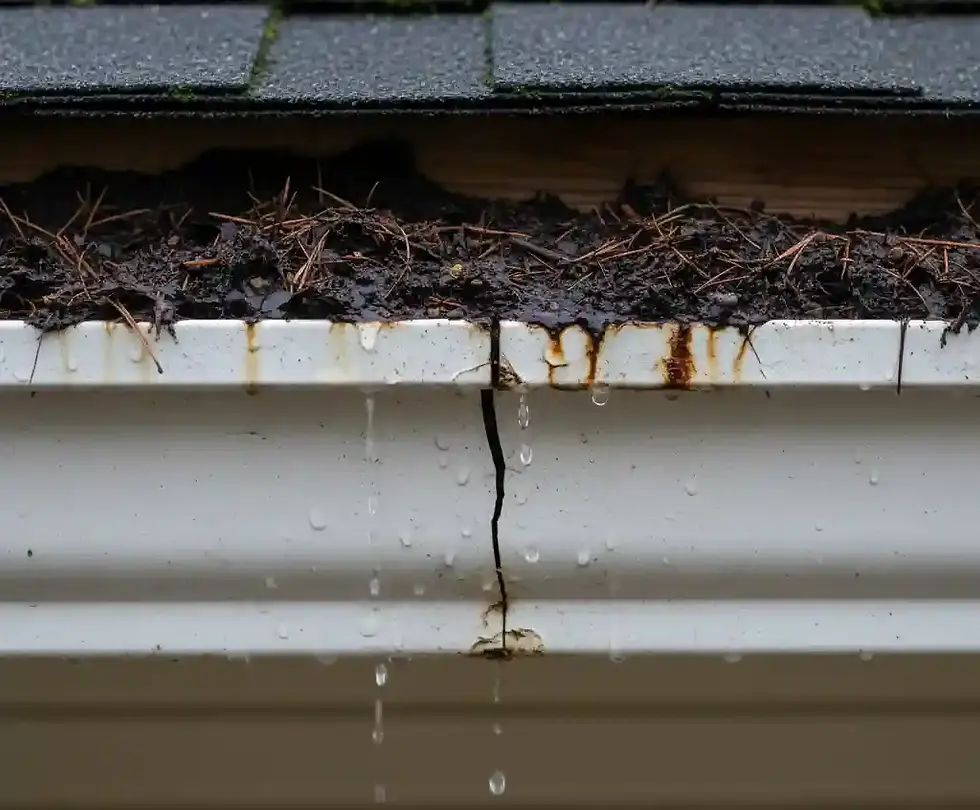
7. Rust, Corrosion or Early Deterioration
Visible rust streaks, pitting inside the trough, or fasteners bleeding orange down the fascia usually trace back to water that sits rather than drains. On a system that isn't near the end of its service life, corrosion is a symptom of pitch rather than age.
What it damages: perforation, sudden section failure during a storm, staining on the siding below.
8. Peeling Paint or Rotted Fascia Behind the Gutters
Blistered paint along the roofline, or fascia that gives when you press it, means water is getting behind the gutter rather than into it. That happens when the trough is hung too high for the drip edge to reach it, hung too low so roof runoff overshoots, or installed without flashing tying the roof edge into the trough.
Homeowners catch this one latest and pay most for it. By the time the paint tells you, the wood underneath has been wet through several seasons.
What it damages: fascia and soffit replacement, roof deck edge rot, and rafter tail repair in the worst cases.
9. Clogging That Keeps Coming Back After Cleaning
Debris is normal. Debris that re-blocks the same outlet weeks after a cleaning is not.
Correct pitch flushes small debris toward the downspout during ordinary rain. A flat or reverse-pitched run holds it, so leaves compost in place and the blockage rebuilds on its own. If you're cleaning the same corner three times a year, the pitch is the problem and the leaves are the symptom. Adding gutter guards to a badly pitched run hides the fault rather than fixing it.
What it damages: the same overflow you cleaned for, plus dead weight the hangers were never sized to carry.
10. Pest Activity Along the Gutter Line
Standing water draws mosquitoes. Gaps at separated joints and sagging sections give birds and rodents a sheltered, level place to nest.
What it damages: blockages, further water backup, chewed soffit and trim.
Gutter Hanger Spacing: The Spec Behind Most Sagging Runs
Of all the numbers in a gutter installation, hanger spacing is the one most often stretched. Every hanger left out is time and material saved, and nothing looks wrong on the day.
Manufacturer technical literature puts the maximum at 36 inches on center, tightening to 18 inches on center in areas where ice and snow persist (Berger Building Products, Proper Gutter and Downspout Sizing). Texas A&M AgriLife Extension lands in the same place on the maximum and goes tighter on the exception: hangers every three feet, or every foot where snow is heavy. Take the stricter of the two if your roof holds snow.
Passaic County sits in the tightening zone for practical purposes. Wet snow loads a trough with far more weight than rain ever does, and a run hung at the 36-inch maximum tends to show its first sag at mid-span after a heavy winter.
Sizing: The Other Spec That Gets Skipped
Spacing keeps the trough on the house. Capacity decides whether it can cope with the storm. Standard residential work runs 5-inch K-style gutter with 2x3 downspouts, and 6-inch gutter with 3x4 downspouts is the step up. The larger profile has a bigger cross-section and so drains a larger roof area, which is why the sizing tables are built around square footage rather than linear feet of gutter.
The judgment call is roof area, roof pitch and how much of it drains to a single outlet. A long run on a steep plane feeding one downspout is the classic undersizing mistake, and no amount of correct slope compensates for it. Berger's sizing tables, cited above, are the reference an installer should be able to point to when you ask why your house got the size it did.
The specs, in one table
Spec | What good practice calls for | Source |
Gutter slope | At least 1/16 inch per foot of run, about 5/8 inch per 10 feet | DOE Building America Solution Center; Texas A&M AgriLife Extension |
Hanger spacing, maximum | 36 in. on center (3 ft) | Berger Building Products; Texas A&M AgriLife Extension |
Hanger spacing, snow and ice | 18 in. on center (Berger); 12 in. on center (Texas A&M) | Berger Building Products; Texas A&M AgriLife Extension |
Downspout discharge | At least 5 ft from the foundation, or underground catchment at least 10 ft out | DOE Building America Solution Center |
Lot grading | Fall of at least 6 in. within the first 10 ft from the wall | IRC Section R401.3 |
Governing code in NJ | 2021 International Residential Code, adopted at N.J.A.C. 5:23-3.21(a)(1) | New Jersey Uniform Construction Code |
A Slope Figure Worth Double-Checking
Search for gutter pitch and you'll find "1/4 inch per 10 feet" repeated across retailer and DIY pages. It doesn't appear in any of the code, national-laboratory or extension-service sources reviewed for this article. The Department of Energy and Texas A&M both specify 1/16 inch per foot, which is 5/8 inch over that same 10-foot run.
Two caveats worth stating plainly. The SMACNA Architectural Sheet Metal Manual, which is the sheet-metal trade's own reference on this, sits behind a paywall and wasn't consulted, so this isn't an exhaustive survey. And a shallower pitch doesn't guarantee standing water; it just gives you less margin, and a run set closer to flat is likelier to hold water at the low points. If your gutters were set to the popular number, that's the thing to go and look at.
What Water Damage Costs When Gutters Fail
Water damage isn't a small line item on a homeowner's policy. Across 2018 to 2022, water damage and freezing claims averaged $13,954 per claim, and in 2022 they made up 27.6% of all homeowners claims (Insurance Information Institute, citing ISO, a Verisk Analytics business).
That's a national, all-cause figure covering burst pipes and appliance failures alongside exterior water, so read it as the scale of the category rather than the price of a gutter problem. It's still worth holding next to the cost of correcting a gutter run, because the four paths below are how a fitting error becomes a claim.
Foundation. Water delivered repeatedly to the same few feet of soil works into hairline cracks, and freeze cycles widen them from the inside.
Siding and roof edge. Overflow behind the trough runs down sheathing and along the roof edge, rotting fascia and lifting the bottom shingle course. Persistent overflow against a wall is also how siding starts to fail early.
Interior intrusion. Saturated soil against a below-grade wall finds the joint between wall and slab. That's why "the basement only leaks in heavy rain" is so often a gutter problem.
Grounds. Concentrated runoff strips beds, undermines walkway slabs and cuts channels across a lawn.
Repair or Replace? How to Decide
The decision comes down to three questions: how old the system is, whether the fault is local or system-wide, and whether you've fixed it before.
Repair is the right call when the gutters are otherwise sound and the fault is contained. A section that needs re-pitching, a run of hangers to add, a corner to re-seal, a downspout to extend. These are installation corrections, and they're the cheapest way out of the problem.
Replace when the trough is corroded through, when sections are separating in more than one place, or when the same repair keeps coming back. If the original install got slope wrong across the whole house, re-hanging the existing material costs nearly what new material does and leaves you with fifteen-year-old aluminum on the wall.
The test that decides most cases: if you're correcting the installation rather than the gutter, repair it. If you're correcting the installation and the gutter is also spent, replace, and get slope, spacing and discharge right from the first day.
How Often Should Gutters Be Cleaned?
Twice a year suits most Passaic County lots: once in late spring, once after leaf drop, plus a look after any storm heavy enough to bring branches down.
Adjust to your lot rather than the calendar. A house under mature oaks in Hawthorne or North Haledon may want three or four passes a year; an open lot with no overhang can often go to one. The signal to watch isn't the schedule but the interval. If debris is back before the next scheduled gutter cleaning, there's a pitch problem underneath the debris problem, and cleaning more often will not fix it.
Checking Your Own Gutters From the Ground
Most of this is visible without a ladder.
During rain. Walk the perimeter. Note any point where water goes over the lip, behind the trough, or off the roof entirely.
After rain. Look for water still standing in the trough, and for ground at the base of the house that hasn't drained.
Count the hangers. Sight along each run. Gaps noticeably wider than a yard are outside the manufacturer maximum.
Follow the downspouts. Measure where each one discharges. Under 5 feet from the wall needs an extension.
Press the fascia. Any softness behind the gutter line means water has been getting in for a while.
Anything on that list is worth a closer look before the first freeze.
Getting a Gutter Problem Diagnosed
Improper gutter installation shows up as water where it shouldn't be, and in Passaic County it shows up sooner than the national averages suggest. Overflow in ordinary rain, a sagging mid-span, standing water long after the sky clears, soft fascia behind the trough: any one of them is worth a look now rather than in January.
NJ Gold Star Construction handles gutter repair, cleaning, guards and new installation across Passaic County, including roof, gutter and chimney work in Totowa, Wayne and Hawthorne. NJ HIC #13VH13359900. Call (862) 271-1225 or request an estimate.
FAQs About Improper Gutter Installation
How much slope should gutters have?
At least 1/16 inch per foot of run toward the downspout, which is about 5/8 inch across a 10-foot section, per the Department of Energy's Building America Solution Center. The commonly repeated "1/4 inch per 10 feet" is considerably shallower and doesn't appear in the technical sources reviewed for this article.
How far should downspouts discharge from the house?
At least 5 feet from the foundation, or into an underground catchment system that outlets at least 10 feet away. Extensions and splash blocks are the inexpensive fix; buried leaders are the permanent one.
How far apart should gutter hangers be?
No more than 36 inches on center, and 18 inches where ice and snow sit on the roof for extended periods. Given northern New Jersey winters, tighter spacing is the safer specification here.
Can poor gutter installation cause basement leaks?
Yes, and it's one of the more common causes. When downspouts release water against the wall, or gutters overflow onto the same strip of soil, that soil stays saturated and water finds the joint between the foundation wall and the slab. A basement that only leaks in heavy rain is usually a drainage problem rather than a waterproofing one.
Where should gutters sit relative to the roof edge?
Just below the roof edge, positioned so runoff off the drip edge lands inside the trough. Hung too high, water runs behind it into the fascia. Hung too low, it overshoots in heavy rain.
Does New Jersey require an ice barrier at the eaves?
Not everywhere, and not automatically. NJ DCA Construction Code Bulletin 07-3, issued in 2007 and revised in 2015, identified the requirement as applying where the average daily January temperature is 25°F or below, which in New Jersey it named as Sussex County. New Jersey now enforces the 2021 IRC, under which the local construction official can require an ice barrier where there's a history of ice forming along the eaves. So check with your municipality rather than assuming either way, and treat ice-and-water shield as a decision about your roof rather than a settled code question.
How often should gutters be inspected?
Twice a year and after major storms. Inspect for pitch and fastening, not just debris, since fitting errors are what turn an annual cleaning into an annual repair.
Sources
U.S. Department of Energy / Pacific Northwest National Laboratory, Building America Solution Center, "Gutters and Downspouts", last updated 26 September 2021.
Texas A&M AgriLife Extension Service, "Rainwater Harvesting: Conveyance", 5 September 2013.
Berger Building Products, "Proper Gutter and Downspout Sizing", Technical Reference Manual.
International Residential Code, Section R401.3 (Drainage). Adopted in New Jersey as the 2021 IRC at N.J.A.C. 5:23-3.21(a)(1), New Jersey Uniform Construction Code.
New Jersey Department of Community Affairs, Construction Code Bulletin 07-3, "Ice Dam Membrane/Ice Barrier", issued May 2007, revised June 2015.
NOAA National Weather Service, Hydrometeorological Design Studies Center, NOAA Atlas 14 Volume 2 Version 3, point precipitation frequency estimates for 40.9026 N, 74.2249 W, partial duration series. Retrieved 9 September 2026.
NOAA National Centers for Environmental Information, U.S. Climate Normals 1991-2020, stations USC00281582 (Charlotteburg Reservoir, NJ) and USW00014734 (Newark Liberty International Airport, NJ). Retrieved 9 September 2026.
New Jersey Department of Health, NJSHAD, "Housing Age: Built Before 1950 / Before 1980, by County, New Jersey, 2018-2022". Data source: American Community Survey, U.S. Census Bureau, 2018-2022 five-year estimates. Published 12 June 2024.
Insurance Information Institute, "Facts + Statistics: Homeowners and Renters Insurance", average homeowners losses 2018-2022, citing ISO, a Verisk Analytics business.
Gutters should be inspected at least twice a year, usually in the spring and fall, and after major storms. Regular inspections help catch installation problems before they cause serious damage.


Comments